> ## Documentation Index
> Fetch the complete documentation index at: https://docs.geckovision.tech/llms.txt
> Use this file to discover all available pages before exploring further.
# Stay correct
> What happens when the upstream API changes — content-addressed surfaces, the regenerable-tool model, and the corpus tripwire. The watcher is V2.
It's Saturday. Nobody shipped anything. Your agent is down anyway — upstream renamed a
field, moved a path, tightened an enum, and your hand-written client knew none of it. It
keeps sending the old shape; the API keeps returning 422; the agent keeps confidently
retrying a call that can no longer succeed.
A hand-written client is a **frozen snapshot of an API that doesn't hold still.** Every
rename is a manual diff a human has to notice, read, and re-code. Multiply by the Nth
painful API and "keep the integrations correct" becomes a standing on-call burden.
## Why the generated-tool model changes the failure mode
Your agent never calls a hand-written client through Gecko — it calls **tools generated
from the spec.** Tool generation is a *pure function of the surface*: same spec in, same
tools out. If the source of truth moves, the tools move with it — you re-comprehend the
surface instead of hand-editing a client.
Gecko knows which surface a tool came from, down to the revision:
```
surface_rev = sha256(canonicalized spec)[:12]
```
Same spec → same `surface_rev`; any edit bumps it. It's a content fingerprint stamped on
the cached comprehension and on **every** correctness record in the corpus.
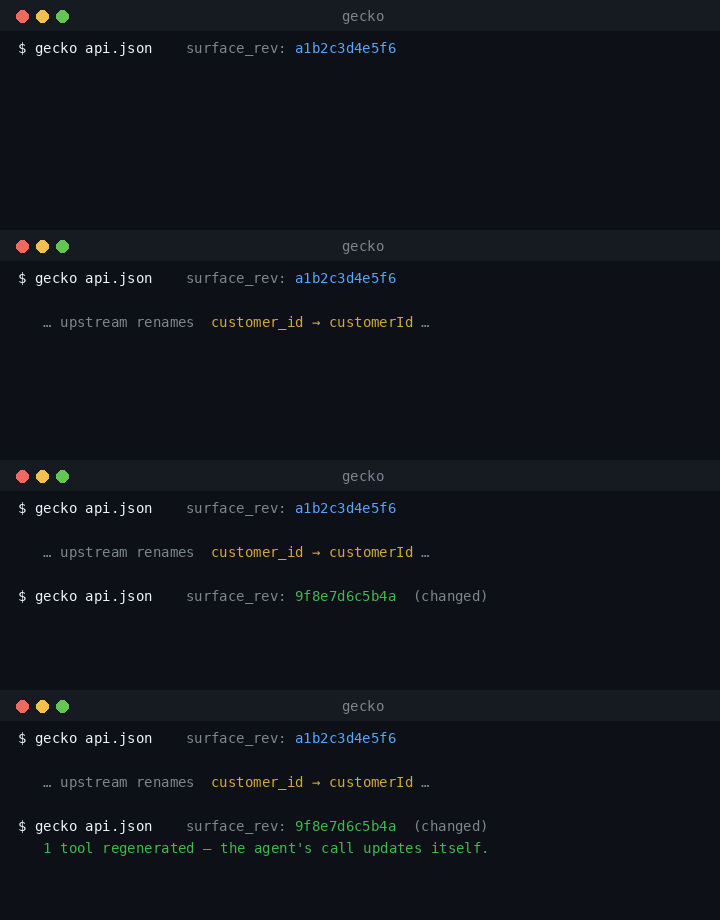 The loop below is **designed; the watcher, the op-level diff, and the alert are V2 and
not yet shipped.** What *is* shipped: content-addressed surfaces, comprehension as a pure
function of the spec, and the control-plane correctness corpus + validator replay. We
won't pretend the cron job exists — the architecture just makes it a small addition, not
a rewrite.
## The stay-correct loop
Poll the spec URL, take a provider webhook, or re-scrape the docs.
Recompute `surface_rev`. Unchanged? Nothing happened, stop.
Run the same comprehension engine on the new spec.
Old `surface_rev` vs new: what params were added, removed, renamed, retyped; what endpoints moved.
Emit the new tool defs and a human-readable changelog of what moved.
## The corpus is your early-warning system
There's a second drift signal that doesn't need the spec to change — because providers
don't always tell you. Every call your agent makes through Gecko logs a
**control-plane-only** outcome: status class, error class, first-call-correct or not, and
the `surface_rev` it ran against — **never** the response body, a param value, or a token
(the writer is a fail-closed allowlist). When a tool that was first-call-correct for ten
thousand calls starts returning `422` / `404` under the same `surface_rev`, the corpus
tells you *something moved* before a human files a bug.
## In one line
A hand-written client makes *you* the diffing engine: read the changelog, edit the code,
hope you caught everything before Saturday. Gecko makes the **spec** the source of truth
and the **tools a regenerable function of it** — so a change propagates instead of
rotting, and the corpus warns you when the surface moves under a spec that never changed.
The loop below is **designed; the watcher, the op-level diff, and the alert are V2 and
not yet shipped.** What *is* shipped: content-addressed surfaces, comprehension as a pure
function of the spec, and the control-plane correctness corpus + validator replay. We
won't pretend the cron job exists — the architecture just makes it a small addition, not
a rewrite.
## The stay-correct loop
Poll the spec URL, take a provider webhook, or re-scrape the docs.
Recompute `surface_rev`. Unchanged? Nothing happened, stop.
Run the same comprehension engine on the new spec.
Old `surface_rev` vs new: what params were added, removed, renamed, retyped; what endpoints moved.
Emit the new tool defs and a human-readable changelog of what moved.
## The corpus is your early-warning system
There's a second drift signal that doesn't need the spec to change — because providers
don't always tell you. Every call your agent makes through Gecko logs a
**control-plane-only** outcome: status class, error class, first-call-correct or not, and
the `surface_rev` it ran against — **never** the response body, a param value, or a token
(the writer is a fail-closed allowlist). When a tool that was first-call-correct for ten
thousand calls starts returning `422` / `404` under the same `surface_rev`, the corpus
tells you *something moved* before a human files a bug.
## In one line
A hand-written client makes *you* the diffing engine: read the changelog, edit the code,
hope you caught everything before Saturday. Gecko makes the **spec** the source of truth
and the **tools a regenerable function of it** — so a change propagates instead of
rotting, and the corpus warns you when the surface moves under a spec that never changed.